
Fire detection that responds at the very first signal
Fire safety systems for public-access (ERP) and workplace (ERT) buildings, from category A to E: designed to the APSAD R7 rule, installed, maintained, with alarms transmitted to the PREVENT APSAD P5 monitoring centre, 24/7. Over 30 years of expertise.

Fire safety covers every device used to detect a fire, alert the occupants, trigger the safety actions planned for the building (evacuation, fire doors, release of emergency exits) and help the emergency services. Coupled with video through AlarmConnect on the INNOVEO platform, every alarm can be verified on screen.
A Fire Safety System (in French, SSI) has a simple job: collect the signals from detectors and manual call points, process them in the control panel, then trigger the alarm and the safety actions. At ANAVEO, it covers six capabilities.
- Detect a fire, automatically (smoke, heat) or through a manual call point
- Alert the occupants with sound and light signals, including people with hearing impairments
- Trigger the evacuation and the safety devices planned for your building
- Transmit the alarm in real time to the PREVENT centre and the emergency services
- Verify the alarm by linking it to the nearest camera with AlarmConnect
- Analyse post-incident data to identify causes and prevent recurrence

The right system depends on your building: its classification (public-access or workplace), its activity, its occupancy and its floor area. That is what sets the fire safety system category (A to E) and the alarm type (1, 2a, 2b, 3 or 4). See how to determine it.
Four fire safety challenges across multi-site estates
Before bringing an estate into compliance, safety managers, public-building (ERP) operators and finance directors face four structural challenges that ageing installations no longer address.
Demanding public-access and workplace regulations
For public-access buildings (ERP), the French fire safety regulation (order of 25 June 1980, as amended) sets the level of detection, alarm and safety actuation by category and type of establishment. For workplaces (ERT), the French Labour Code applies. A mixed estate is hard to keep at the right level on every site.
Insurer requirements to document
Insurers expect installations that follow good practice, are serviced and inspected. Without an up-to-date safety register and traced inspections, the discussion after a loss becomes difficult.
Costly false alarms
A false alarm interrupts business, can call out the emergency services for nothing and wears down staff confidence. Every false evacuation weighs on operations.
High-risk areas to treat separately
Stockrooms, technical rooms, electrical cabinets, kitchens, cold rooms, ATEX zones: each area calls for the detector suited to its risk (smoke, heat, linear detection) and its environment, to detect early without false alarms.
The four trades of fire safety, and ours
A building’s fire safety relies on four complementary trades. ANAVEO’s core business is the first one: detection and alarm. The other three are studied with you, according to your site.
Detection and alarm: our core business
Automatic detectors, manual call points, control panel, sounders and visual alarm devices: ANAVEO designs, installs and maintains your building’s fire safety system, from category A to E and for every alarm type.
Extinguishing
Studied with you according to your site and your risk.
Compartmentation and smoke control
Fire doors, dampers, smoke control: studied with you according to your building. The ANAVEO system drives the safety devices planned.
Safety signage
Evacuation plans and instructions: studied with you according to your site.
Which fire safety system for your building?
ANAVEO equips public-access buildings (ERP in French: shops, hotels, healthcare facilities, offices open to the public) and workplaces (ERT: warehouses, industrial sites, offices). Each building is assigned a fire safety system category and an alarm type. ANAVEO covers them all.
| Alarm type | System category | Activation | What it covers |
|---|---|---|---|
| Type 4 | D or E | Manual | The simplest system, battery or mains powered. |
| Type 3 | C, D or E | Manual | One or more self-contained alarm sounders (BAAS). |
| Type 2b | C, D or E | Manual | A main sounder unit linked to satellite sounders. |
| Type 2a | B | Automatic | Alarm driven by a control and indicating equipment. |
| Type 1 | A (mandatory) | Automatic | The most complete level: automatic fire detection, control and indicating equipment (ECS) and fire safety centraliser (CMSI). |
The 4 facts that size your fire safety system
To advise and equip you accurately, our experts start from four pieces of information.
- Building type: public-access or workplace
- Type of operation: shop, warehouse, hotel, offices, healthcare…
- Occupancy on site: public and staff
- Floor area: for retail, the sales area, stockrooms excluded
Example, retail store: public occupancy is calculated on the sales area, at one person per 3 m² in the basement, on the ground floor and on the 1st floor, one person per 6 m² on the 2nd floor and one person per 15 m² on higher floors (article M 2 of the French fire safety regulation).
Emergency exits under access control: the compliance few master
In a public-access building, an emergency exit fitted with access control must be slaved to the fire safety system: when the alarm sounds, it unlocks and stays open for the whole evacuation of customers, not just while the sirens sound.
Timed release
24 V magnetic locks and a contact held open for the evacuation time, from the fire safety centraliser or the control panel, or through a dedicated release unit.
Two trades, one installer
ANAVEO installs both your access control and your fire safety system: the interlock is designed in from the start, with no shifting of responsibility between two providers.
Approved in writing
Any specific operating mode is approved in writing by the fire safety coordinator or the inspection body, and recorded in the installation file.
From detector to alarm: equipment chosen zone by zone
ANAVEO selects, installs and maintains the equipment suited to your building’s system category and to the risk of each zone, to the APSAD R7 rule, with alarms transmitted to the PREVENT centre.
Smoke detection
Optical smoke detectors: good early warning on smouldering fires, up to 12 m high. Placed in the centre of corridors, the first 4 to 5 m from the wall, then every 10 m.
Heat detection
Rate-of-rise and fixed-temperature heat detectors for kitchens, workshops and areas where smoke or dust would cause false alarms.
Linear smoke detection
For large volumes (warehouses, halls, sales floors): a single linear detector covers 80 to 1,000 m², up to 12 m high, for light and dark smoke alike.
Control panel, alarm and transmission
The heart of the system collects the signals, processes them and triggers the actions, zone by zone.
- Control and indicating equipment (ECS) and, in category A, a fire safety centraliser (CMSI)
- Manual call points on every floor, near stairways and exits
- Sounders out of the public’s reach and visual alarm devices wherever a person with hearing impairment may be alone, and in noisy areas
- Control of the planned safety devices: fire doors, release of emergency exits
- Alarms transmitted to the PREVENT APSAD P5 centre, 24/7
- Neutronic equipment, a French manufacturer, for type 2b, 3 and 4 alarms
See, Perceive, Foresee: the INNOVEO philosophy applied to fire safety
Three families of Smart Apps structure the INNOVEO ecosystem, mirroring the three operational stages of fire safety.
Detect a fire at the very first signs
Automatic detection suited to each zone (smoke, heat, linear), complemented on sensitive areas by continuous thermal monitoring.
Qualify the alarm and verify it on video
The alarm reaches the PREVENT centre with the image of the zone concerned: verification happens before any call-out.
Anticipate the incident and keep the evidence
Preventive thermal monitoring of sensitive areas and off-site recording of triggered sequences, intact even if the equipment is destroyed in the fire.
AlarmConnect amplified by the INNOVEO Smart Apps
AlarmConnect links every alarm to the site’s video on the INNOVEO platform. Six combinations show what a fire safety system connected to video surveillance, access control and remote monitoring brings.
AlarmConnect + linked camera
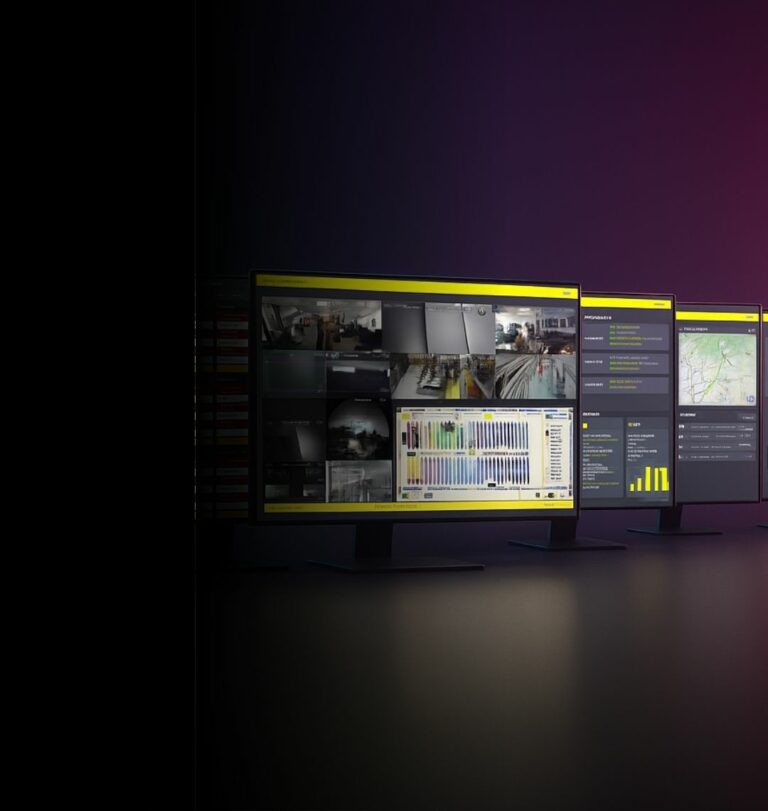
As soon as the alarm is triggered, the nearest camera opens full-screen and the operator is notified: the event is qualified on video.
Video verificationAlarmConnect + HeatTracker
Thermal cameras complementing fire detection on sensitive areas (storage, electrical cabinets, machines, cold rooms): an alert as soon as a temperature crosses the set threshold.
Thermal monitoringAlarmConnect + SmartOverview
Interactive site plan: the camera of the zone in alarm appears at its real position, to guide teams and emergency services without hesitation.
Interactive planAlarmConnect + CloudTracker
Off-site recording in the ANAVEO sovereign cloud of the sequences triggered by a fire alarm. Evidence stays intact even if the equipment burns, which matters for the insurer.
Cloud evidenceAlarmConnect + access control
Release of the emergency exits under access control for the whole evacuation, as public-access building rules require. Learn more.
Emergency exitsAlarmConnect + PREVENT
The alarm is transmitted to the APSAD P5 certified monitoring centre, 24/7: verification, application of evacuation procedures and transmission to the fire brigade if the alarm is confirmed.
PREVENT centreFire safety by sector: retail, industry, healthcare, offices, hospitality, SMEs
Depending on activity, occupancy and floor area, the system category and the equipment differ. Six major business sectors served by ANAVEO.
- Retail and large-scale distribution: sales floors, stockrooms, cold rooms, emergency exits under access control, HeatTracker on technical rooms and switchboards
- Industry and logistics: linear detection of large volumes, ATEX zones, heat detectors in workshops
- Healthcare: zoned alarm, visual alarm devices, access interlocks
- Offices: smoke detection in offices and corridors, HeatTracker on technical rooms
- Hospitality and catering: detectors suited to kitchens, zoned alarm
- SMEs and local shops: type 3 or 4 alarm, preventive maintenance included
Fire safety is more than an alarm. It is sized for the building, detects according to each zone’s risk, alerts everyone, triggers the planned safety actions and sends the alarm to a centre that keeps watch 24/7.
Three immediate ROI levers on a fire safety deployment
Well-structured fire safety transforms the economics of risk. Three direct benefits for our multi-site clients.
False alarms eliminated
AlarmConnect links every alarm to the site’s video: verification happens before any call-out, which limits false evacuations and unnecessary emergency-service trips.
Video alarm verification by AlarmConnect, on the INNOVEO platform.Critical alerts handled in under 60 s
The PREVENT centre, certified to APSAD P5, handles the alert in under 60 seconds. Fast response, compliant with insurance requirements.
ANAVEO PREVENT performance, APSAD P5 approved.Single point of contact
Detection, video, remote monitoring and maintenance are run by a single provider on INNOVEO: one responsibility, one contract, one register.
ANAVEO organisation: 18 branches, PREVENT centre and INNOVEO platform.Discover ANAVEO’s other areas of expertise
Fire safety is part of an ecosystem of six other ANAVEO areas of expertise, all orchestrated on the INNOVEO platform for unified security.


SSI, NF standards and EN 54: compliance from the design stage
Fire safety is one of the most heavily regulated fields in France. Several frameworks govern detection, alarm, safety actuation and the certification of installations.
| Standard / text | Scope | ANAVEO response |
|---|---|---|
| French fire safety regulation for public-access buildings (ERP) | Order of 25 June 1980, as amended: detection, alarm and safety actuation by category and type of building | Recommendation of the right system for each site and activity, safety register kept up to date |
| System categories A to E | Protection level by building; a type 1 alarm is always paired with a category A system | Every category and every alarm type, in public-access and workplace buildings |
| APSAD R7 rule | CNPP framework for automatic fire detection | Installations designed to the APSAD R7 rule, carried out with certified partners or under APSAD coordination |
| NF S 61-931 / NF S 61-932 / NF S 61-970 | French standards for fire safety systems, their installation rules (detection, safety and alarm zones) and alarm equipment | Compliant zoning, fire cables suited to each link, NF-marked equipment, documented testing and commissioning |
| EN 54 | European standard for fire detection and alarm components | EN 54 certified equipment, guaranteed interoperability and quality of detectors and panels |
| APSAD P5 | Alarm remote monitoring | PREVENT centre certified to APSAD P5, 98.85% of critical alerts handled in under 60 s, 24/7. See our remote monitoring expertise |
| French Labour Code R.4227-28 to R.4227-42 | Employer obligations regarding fire in the workplace | Video alarm verification by AlarmConnect, mandatory periodic inspections included in the maintenance contract |
Going further: understanding APSAD certifications, cybersecurity and business regulation, GDPR legal framework.
Six reasons to trust ANAVEO with your fire safety
ANAVEO brings together six decisive strengths for high-performing multi-site fire safety: PREVENT APSAD P5 remote monitoring, regulatory compliance tracked site by site, a unified INNOVEO platform, national coverage, the PREVENT centre and guaranteed post-incident evidence.
Our network of 18 branches ensures a 24 to 48 hour response across the whole territory, with field teams who install and maintain fire detection systems.

APSAD P5 remote monitoring
PREVENT centre: 98.85% of critical alerts handled in under 60 s, 24/7.
Compliance tracked site by site
Your installations stay compliant with no effort on your side.
INNOVEO: a unified platform
Fire, video surveillance and access on a single interface.
600 experts, 18 branches
Response in 24 to 48 hours, annual inspections included.
PREVENT centre 24/7
98.85% of critical alerts handled in under one minute.
Guaranteed post-incident evidence
Footage externalised in CloudTracker, intact for the insurer.
They trust us


The ANAVEO footprint in fire safety
Made in France. AlarmConnect designed and operated in France, INNOVEO platform built in France, data hosted on French soil, sovereignty guaranteed.
Fire safety before and after ANAVEO
Safety managers, ERP operators and finance directors see it every day: moving to an SSI driven on INNOVEO transforms regulatory compliance, risk control and the relationship with the insurer.
Before ANAVEO
- Mixed estate, uneven system level from one site to another
- Repeated false evacuations (kitchen false alarms)
- Emergency call-outs on false alarms
- Emergency exits under access control not slaved to the fire system
- Mandatory inspections not traced
- Video evidence lost if the equipment burns in the fire
After ANAVEO
- System level recommended site by site, safety register kept up to date
- False alarms filtered by AlarmConnect video verification
- Alarm transmitted to the PREVENT centre, emergency services called after verification
- Sensitive areas doubled by HeatTracker thermal monitoring
- Periodic inspections and regulatory updates included in the contract
- Sequences stored off-site in CloudTracker, evidence intact for the insurer
From study to maintenance
Site visit and data collection
Building classification and category, existing installation, heights (roof spaces, false ceilings, mezzanines), specific equipment, risks by zone, scale plan.
Study by our design office
System category and alarm type, zoning, choice of detectors, to the APSAD R7 rule and the NF S 61 standards.
Installation
ANAVEO technicians and certified partners, suitable fire cables, interlocks (emergency exits, safety devices), transmission to the PREVENT centre.
Testing and commissioning
Test of every call point, detector and sounder, test of the interlocks, handover of the file and the operating manual.
Maintenance by ANAVEO
Servicing visits and periodic inspections recorded in the safety register, repairs, 24/7 remote monitoring by PREVENT.
Everything about fire safety in eight questions
Is fire safety mandatory for my business?
Yes. In France, public-access buildings (ERP) fall under the fire safety regulation (order of 25 June 1980, as amended) and workplaces (ERT) under the Labour Code (articles R.4227-28 to R.4227-42). Obligations vary with the classification, activity and occupancy. Periodic inspections are recorded in the safety register.
What is the difference between a public-access building (ERP) and a workplace (ERT)?
A public-access building receives the public, freely or by invitation, paying or not: shops, hotels, healthcare facilities, meeting rooms. A workplace receives only workers: warehouses, workshops, offices closed to the public. Different rules apply: the public-access building regulation on one side, the Labour Code on the other. ANAVEO equips both.
How do I know which fire safety system category applies to my building?
The system category (A to E) and the alarm type follow from the building’s classification, type of operation, occupancy (public and staff) and floor area. Our experts determine the right category during the audit, from these four facts and the site plan.
What is the difference between type 1, 2a, 2b, 3 and 4 alarms?
Types 4, 3 and 2b are manually activated: from the simplest system (type 4) to self-contained sounders linked together (type 2b). Types 2a and 1 are automatic. Type 1, the most complete, is always paired with a category A system, with automatic fire detection, control and indicating equipment and a fire safety centraliser.
How is the occupancy of a store calculated?
For a retail store, public occupancy is calculated on the sales area (article M 2 of the French fire safety regulation): one person per 3 m² in the basement, on the ground floor and on the 1st floor, one person per 6 m² on the 2nd floor and one person per 15 m² on higher floors. Low-density stores count one person per 9 m². To classify the building, staff are added unless they have independent exits.
Which APSAD rule covers fire detection?
Automatic fire detection falls under the CNPP’s APSAD R7 rule. ANAVEO designs its installations to the R7 rule and carries them out with certified partners or under an APSAD coordinator. The APSAD D32 document, sometimes wrongly cited for fire, deals with the cybersecurity of security systems.
My emergency exits are under access control: what do the rules say?
In a public-access building, an emergency exit fitted with access control must be slaved to the fire safety system: when the alarm sounds, it unlocks and stays open for the whole evacuation, not only while the sirens sound. Magnetic locks are powered at 24 V. As ANAVEO installs both the access control and the fire system, the interlock is planned from the design stage.
What maintenance does a fire alarm system need?
A fire safety system is serviced and inspected periodically: test of call points, detectors and sounders, battery operation test, check of the interlocks, results recorded in the safety register. Maintenance is provided by ANAVEO, with repairs through our 18 branches and 24/7 remote monitoring by the PREVENT centre.
Assess the fire safety compliance of your estate
Our experts deliver a tailored framing: compliance audit, mapping of high-risk areas, recommendation of the SSI level suited to your ERP category, compliance plan. No commitment, with concrete figures.
- Framing within 48 h
- No commitment
- Free